Musculoskeletal Motion Imitation for Learning Personalized Exoskeleton Control Policy in Impaired Gait


Abstract
Designing generalizable control policies for lower-limb exoskeletons remains fundamentally constrained by exhaustive data collection or iterative optimization procedures, which limit accessibility to clinical populations. To address this challenge, we introduce a device-agnostic framework that combines physiologically plausible musculoskeletal simulation with reinforcement learning to enable scalable personalized exoskeleton assistance for both able-bodied and clinical populations. Our control policies not only generate physiologically plausible locomotion dynamics but also capture clinically observed compensatory strategies under targeted muscular deficits, providing a unified computational model of both healthy and pathological gait. Without task-specific tuning, the resulting exoskeleton control policies produce assistive torque profiles at the hip and ankle that align with state-of-the-art profiles validated in human experiments, while consistently reducing metabolic cost across walking speeds. For simulated impaired-gait models, the learned control policies yield asymmetric, deficit-specific exoskeleton assistance that improves both energetic efficiency and bilateral kinematic symmetry without explicit prescription of the target gait pattern. These results demonstrate that physiologically plausible musculoskeletal simulation via reinforcement learning can serve as a scalable foundation for personalized exoskeleton control across both able-bodied and clinical populations, eliminating the need for extensive physical trials.
Method Overview
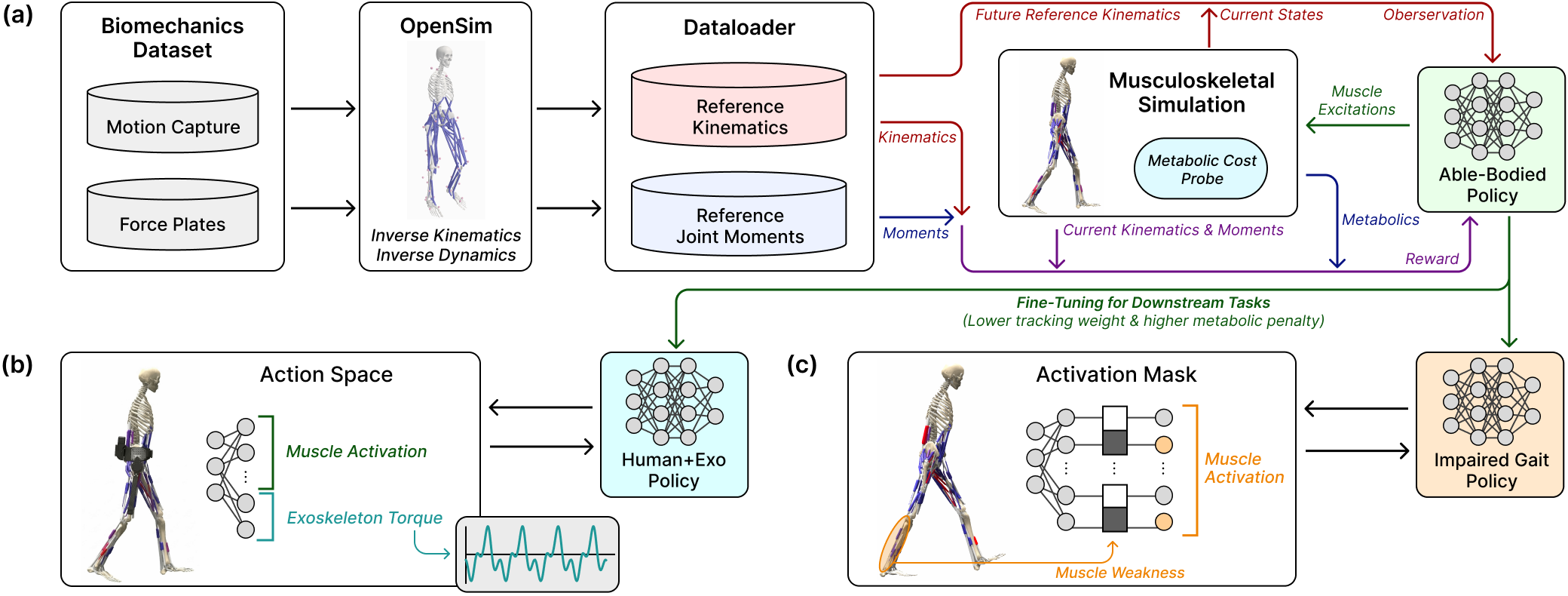
Overview of the musculoskeletal simulation and learning framework. (a) From an open-source biomechanics dataset, the policy observes future reference kinematics and outputs muscle activations to imitate able-bodied human locomotion. (b) Fine-tuning phase for the human-exoskeleton system. The action space is extended to include assistive torque motors alongside muscle activations to simulate exoskeleton assistance. (c) Fine-tuning phase for the impaired gait policy. An activation mask reduces the maximum excitation of targeted muscles to generate compensatory impaired gait patterns. Both conditions can be applied simultaneously to generate impaired-gait-specific exoskeleton assistance.
BibTeX
@article{choi2026musculoskeletal,
  title={Musculoskeletal Motion Imitation for Learning Personalized Exoskeleton Control Policy in Impaired Gait},
  author={Choi, Itak and Park, Ilseung and Halilaj, Eni and Kang, Inseung},
  journal={arXiv preprint arXiv:2604.09431},
  year={2026}
}